

Showing posts with label disasters. Show all posts
Showing posts with label disasters. Show all posts
Sunday, May 9, 2010
priority for action 4

Thursday, May 6, 2010
pédagogie des catastrophes

Fox News might have been a little bit extreme in blaming the collapse to a deliberate sabotage, Texas Governor Rick Perry instead claimed that the oil rig collapse be an "Act of God" (a man-made disaster!). Then changed his mind and called it a "technical failure". While the first two definitions are obviously an attempt to deny any responsibility by BP, calling what happened a "technical failure" is part a more subtle strategy.
Drilling 1500 m underwater a 6000 m deep hole is a challenge for our most advanced technology. It is risky, and can result in unpredictable, or unavoidable, events. BP might be found guilty of not having installed an extra security switch (compulsory in Brazil and Norway) in case the main one fails, of having downplayed the emergency in the beginning, of having reacted slowly or ineffectively. And it might be fined or have to pay the cleaning and the damages.
But what's really at stake for the company, as well as for any other major player in this field, is not to have to install an extra switch on each pipe or even to be fined for US$ 16 billion to repay the losses. These guys' annual income is higher than that. They wouldn't go out of business if the environmental or security regulations changed. What they really need is to avoid the deep cultural change that events like this could cause.
The Exxon Valdez and the Prestige disasters, the Sidoarjo mud flow, as well as swine flu, avian influenza, E. Coli or Salmonella outbreaks from contaminated food in the US, the Great Pacific Garbage Patch, even natural disasters like Katrina or the earthquakes in Haiti and China are presented and elaborated in our memory as unique situations that have different technical causes, that a different technical solutions might have avoided. That will never happen again, once the technology is available and the laws are respected.
But they collectively are a demonstration of the hidden costs of our development. Environmental degradation, social inequalities, reduced health and security levels, are all consequences of the same economic processes aimed at making available on a large scale any sort of cheap consumer goods. As long as we consider this kind of consumption a fundamental right of ours, the very basis of our lifestyle, of our culture, we keep reproducing the conditions that lead to such disasters, making cheap fossil fuels and cheap labor desirable, and strong environmental and security regulations, social services and welfare deleterious. We choose to maintain a system in which somebody else is subsidizing part of our well-being with his own.
These choices might not be conscious. Externalities are mostly invisible, either hidden from our sight or so diluted we can't really realize their existence. Disasters (both man-made and natural) can be useful in revealing them, uncovering some of the indirect implications of the ways societies work. Of how we decide to produce and consume stuff, to distribute resources and profits. Of where the weaknesses of our system are. Disasters like this can be a wake-up call for the people.
But it is fundamental to let such an event speak. Calling it, telling it a certain way, means giving it a certain meaning, and it's not a neutral process. Isolating each situation, making it one more different accident in a disorganized series of technical failures, might work just fine in preventing the very same event from happening again. It surely works perfectly in hiding the need for a more substantive, radical change.
Friday, April 23, 2010
'cause I, I built my life around you

First act of the new governor of Campania: stop the demolition of illegal buildings and settlements, to be enforced starting next week. here.

In Naples there's no real favela or bidonville, with the exclusion of some gypsy camps and some overcrowded informal buildings, mostly occupied by illegal immigrants. Still, there are a few areas that can be considered slums, such as decayed central historical areas and public housing residential peripheries. And there is, all around the urban centre, a whole city that has been built in the 1970s and 1980s, mostly on agricultural land, in violation of existing urban plans, composed of small constructions or single-family homes.
The majority of these buildings are not really informal. They are good-quality houses, that might even respect building standards, mostly built by firms connected to the Camorra for the local lower-middle class or for bigger entrepreneurs. They are illegal, because they have been built despite the land zonation and in the lack of sufficient infrastructures and public services. They basically are a form of investment, extremely efficient as a means of cleaning money from illegal sources, that relies on the fact that a local or national government will eventually be issuing an amnesty, and transform a construction lacking a planning permission into a perfectly legal (and way more valuable) property.
The population in the region has gone up by roughly 120,000 units since 2001, and, in the meanwhile, 60,000 illegal buildings have been built. They are not there to satisfy a fundamental right. They are pure business. And a rentable one, since they allow the externalization of a series of environmental and social costs on the rest of the community. I get a cheap house, or a good profit, or a low rent, somebody else (or even me and my family) in a not-so-uncertain future, will have to bear the consequences, in terms of poorer access to public services, lower environmental quality, loss of amenities and property value, social instability due to criminal organizations' increasing power, economic damages, injuries, death.
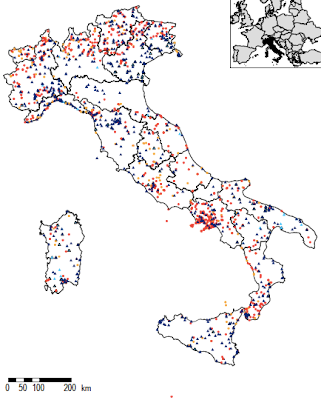 Landslide and earthquake risk, in particular, are positively related to urbanization rates, especially in areas where the constructions are not properly planned. That is to say that communities with high percentages of illegal housing are likely to suffer more victims and damages from events of a given intensity. And in the case of landslides, environmental degradation associated with urbanization is also a factor in increasing the frequency of the events themselves.
Campania, as a region, occupies 4,5% of the Italian surface, and has experienced about 14,5% of the landslide disasters ever recorded in the country, which probably make it the one national hydrogeological risk hotspot, with a notable concentration of deadly landslide events in the Naples province (red dots in the map). It has been the stage of the costliest earthquake ever recorded in Europe and will sooner or later have to face the inadequacy of the Vesuvius emergency plan, largely due to the area's over-urbanization and insufficiency of infrastructures.
The announced stop to the demolition of illegal buildings, which possibly preludes to a real amnesty, is not going to make things any better. It might actually encourage people to build even more, and even worse. Sadly enough, is not always possible to directly connect the dots between such an administrative act and its single consequences, and have politicians sued for their political responsibilities when a farmer is killed by a mudflow, or a journalist by a bullet. But such a way of managing the territory, being aware of the environmental and social situation of our area, are simply premeditated crimes. And a telling start of a new mandate.
Tuesday, April 20, 2010
island-mountain glacier

Information is beautiful gets the CO2 emission figures for the volcano wrong, their graph goes viral. Apologies and new visual here - way less extreme than the first.
I have the impression people coming back from overland trips happy for the adventure, challenge, poetry of an out-of-time journey will go back on a plane as soon as the authorities allow it. Still, I'm wondering if the landslide of offers on carpooling websites will increase in the long term the number of people using this kind of transport, maybe for shorter distances.
Whoa pictures of the volcano, here.
WMO says the effect of the eruption on global warming will be "very insignificant" (too small, too low, too sparse), and could only affect the regional climate if it went on for years. here.
It's sad to notice, though, how financial crisis, depressions, natural disasters are among our biggest achievements in terms of climate change mitigation. The fact that we could consider these disruptions as success stories is the biggest evidence for the unsustainability of our economies.
Saturday, January 16, 2010
the uses of Haiti/2

As you can probably notice, this is a long one. Not really "writing for the web".
That a country which has been first a slave-labor-based plantation, then a militarily occupied territory, lastly the personal domain of a handful dictators, may have been able to autonomously determine its economic policy, already sounds like an overstatement. Whenever the Haitians have tried to pursue an idea of self-determined government there has always been a foreign power ready to restore things the way they used to be. To me, whatever system they live in today, it looks rather imposed than freely chosen.
That Haiti is an example of anti-capitalistic economy is plain wrong. The country has been re-populated with Africans to be used as a plantation to meet the western countries' needs. It is actually a manifestation of what globalization already looked like in pre-industrial period. And, with a little help of the US, it's stably been a free market economy in the last century. Just an extremely poor one, where development has never happened.
That capitalism should be the reason our lives are so good, I find even more debatable. The argument there is quite a common one. Our system is right because our life expectancy, per capita GDP and material consumption are higher, and this has been made possible by capitalism, free market, and industrial revolution.
In fact, the better lifestyle of citizens of advanced economies depends only in part on the widespread availability of cheap commodities and services (food, water, clothes, sanitation, transportation, heating systems) which have indeed been made available by mechanization of productive activities and fast and free circulation of wares. It is also founded on a whole set of measures that redistribute profit to ensure social security and welfare.
Every State defines boundaries outside of which a measure that could be desirable, since it makes an activity more profitable, becomes illegal, because it creates a series of negative side-effects, of externalities, that a society can't afford. We take for granted that children shouldn't be allowed to work, that nature should be safeguarded, that men and women should be equally paid, that any working environment should be safe and that workers should be protected in case of accidents or sickness. And most of the developed States, through progressive taxation, generally ensure that good education and work opportunities are not restricted to those who can pay for them, that health care is available to all, that people have a fulfilling life when they're retired or unemployed.
These measures are essentially anti-capitalistic. They modify the market and limit the accumulation of wealth to guarantee every citizen the access to a set of fundamental, non negotiable rights. They have been progressively conquered by the civil society with a struggle against the capital, and finally imposed though democratic legislation. Without the definition and the respect of this set of rights, the lumpenproletariat that populated European cities a couple of centuries ago wouldn't probably be any better off.
We have been quite good in producing and enforcing these rules in our countries (although not uniformly), but the same hasn't happened on a worldwide scale. Actually, we are more and more experiencing the opposite.
In the absence of internationally recognized standards and rights, low fossil-fuel-based-energy prices have contributed in creating a kind of "international reserve army of labour", composed of developing countries that have all the interest in keeping regulations as loose as possible, to lower the production costs and be more competitive. In order to maximize profits, many productive activities (especially industrial, labour intensive, polluting ones, that require less qualified manpower) have moved to countries where the labour is cheap and workers are not guaranteed, where the environmental legislation is non existent, where safety regulations are not respected, building codes not enforced, urban growth not managed. And where any form of development would make production more expensive, leading to the loss of the competitive advantage, of the only reason why a certain activity is carried out right there.
This process has become absolutely fundamental in ensuring material well-being of consumers in developed countries. Our access to cheap food, clothes, cars, fuel, and so on, is totally based on it. Its consequence is that socio-economical and environmental externalities have been moved out of our sight, giving us the illusion of living in the best of possible worlds, but, in reality, drastically worsening the life conditions of billions living somewhere else. Prosperity chez nous is actually based on environmental destruction and social injustice chez eux. Simply, we don't care.
Haiti's current situation is not just a failure of the prevailing international economic system. It is absolutely organic to it. Unregulated globalized capitalism needs "black holes" to accumulate its externalities. It needs a Lake Victoria for its perch fillets, it needs an Amazon forest for the soya to feed its cows, it needs a Bhopal to establish its dangerous activities. And it also needs places like Naples to dump its toxic waste, or Rosarno (or the old part of New Orleans) to pile up cheap manpower.
It always directs its undesirable side-effects to places where laws and regulations are non existent, or non enforced. There always are places like that. They can be managed, conserved, and even be created, through military interventions, financial crisis, coups, civil wars, embargoes, and conflicts.
It's really not about the poor countries being too under-developed. Not only following us on our "development" path is not going to solve their problems; it is actually what's causing them. Without boundaries and constraints, the capitalist production system tends to create "islands of wealth in oceans of poverty". And it will keep preventing a large share of the world population from having its basic needs met, its fundamental human rights respected.
This system we live in can only look good if we decide that liberté, égalité, and fraternité only apply to those that already are free, equal, and similar to us. We found them such good ideas for ourselves, why should it be any different with a few other billion people?
Thursday, January 14, 2010
the uses of Haiti

Ok, Haiti hadn't experienced major earthquakes in the last 200 years.
Ok, since 1692 in the whole region there have been only 3 recorded quakes which have caused more than 1000 victims, the deadliest being the 1843 Leeward Islands one, with 5000 deaths.
Ok, the event was very close to the major urban area in the country, and very shallow, and hit Port-au-Prince with extreme violence. And strong aftershocks further damaged the area.
But a disaster such as this is really not a question of bad luck. You might not know when the earthquake is going to happen, but you can be quite sure that having a couple of million people in poorly built houses on the top of a fault which has been accumulating energy during the last two centuries is going to lead to a massacre, sooner or later.
Haiti is usually considered the perfect case study to explain the concept of vulnerability to disasters. Together with the Dominican Republic, it occupies the island of Hispaniola, which is struck almost yearly by some hurricane. The two countries are subject to winds of the same strength, rains of the same intensity, waves of the same height. But the same event that on the Dominican side would kill 1, makes 6 victims on the Haitian one.
This is not about the Dominicans being luckier. Rather, it is about the Haitians being poorer. A huge, poor population that ends up living and working in cheap, fragile buildings in cheap, dangerous areas, such as steep slopes and riverbeds. That relies on its local environment for food and energy provision, contributing to the overexploitation of the island's forests (which causes the soil to become less stable and less able to retain rain, and makes water runoff more violent, increasing frequency and intensity of floods and landslides) and of its coastal ecosystems (which protect people and their livelihoods from coastal hazards). That has never experienced a period of democratic stability and development. That can't count on any kind of welfare state, urban planning and building codes, decent health care, disaster preparedness system, or recognition and satisfaction of basic human rights.
This earthquake surely dwarfs any other event on the records, but in the last 10 years the country has already been hit by 37 major natural disasters, including the 2008 hurricanes (Fay, Gustav, Hanna, and Ike) which killed about 800 and left 800,000 homeless, and the 2004 hurricane Jeanne, with its 2750 victims. The country is so vulnerable that almost every time a strong natural event hits it people are killed, buildings are destroyed, properties are lost.
In explaining these disasters, the human components are much more relevant than the violence and unpredictability of the natural events. And are deeply rooted in the country's history. This is where the appeals for funding, the emergency interventions, and a world-wide mobilization of people and resources fall short.
Obama, who now promises full support to the country, should remember how systematically US have undermined Haitian democracy throughout the last century with the aim of exploiting the country's resources and market, first as direct occupiers, then leaving the country in Trujillo's hands, financing the 30-years long Papa Doc and Baby Doc Duvalier's regime, and contributing to the coup that, in 1990, overthrew Jean-Bertrand Aristide, the first democratically-elected leader the nation had ever had. The International Monetary Fund and the World Bank, who now pledge financial and technical aid, should remember how happy they've been with the neoliberal regime US created to "restore democracy" in 1994, which worsened the life conditions of an already desperate population, or how passively they have acknowledged the embargo US imposed on the country after the 2000 local elections, which the Americans considered "irregular".
Under these conditions, is it any surprising that the population have basically experienced no development in the last two centuries? Could a country where the rights of the workers have been systematically denied, where the poor, black population has always been considered a danger for the capital, where wealth and power have been systematically concentrated in the hands of a handful families, turn out to be any different?
It's not a question of collecting more money, of rescuing the thousands buried alive, of providing food and shelter to the survivors. And it's not only question of building safe houses, schools, hospitals, infrastructures. Poverty and vulnerability won't disappear that way. Without a profound modification of the nature of the economic and political relations at the national and international levels, there's no way to avoid the progressive construction of catastrophes such as this earthquake, there's no way to avoid the fact that there will always be a former tropical paradise ready to be turned into a terrible hell circle.
Subscribe to:
Posts (Atom)